Choose supervision
Use an established surf school or qualified instructor familiar with that day’s beach and local safety practice.
Learning / field note 09
Small, supervised steps turn a first session into practice rather than a test of nerve.
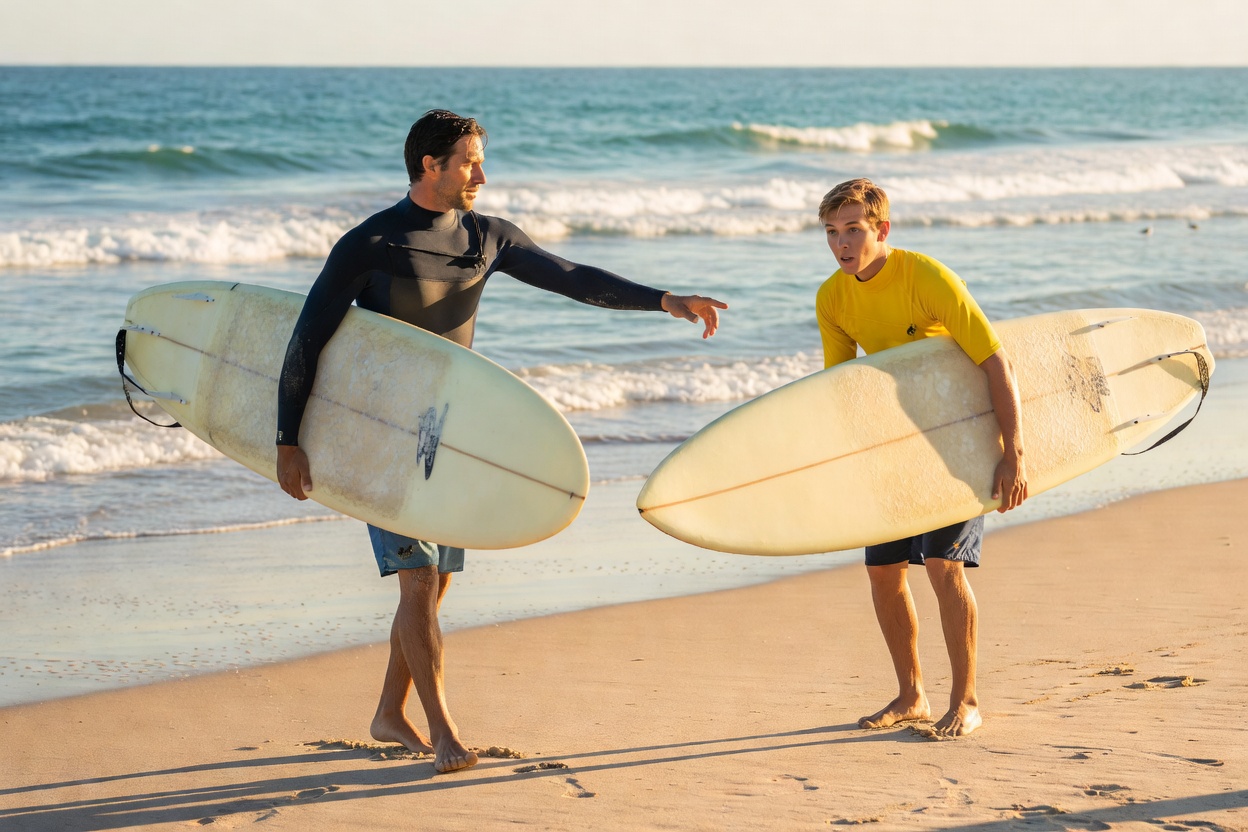
A qualified instructor can explain how to carry a board with its nose low, where a leash belongs, why the board must never be released near others, and how today’s shoreline works. These details are not ceremony; they reduce avoidable collisions before water is involved.
For many learners, a stable soft-top board in waist-deep whitewater is more useful than a small hard board beyond the break. Equipment should serve control, not appearance.
Use an established surf school or qualified instructor familiar with that day’s beach and local safety practice.
Lie centred on the board, eyes forward, and learn a controlled prone ride before worrying about standing.
Attempt the pop-up only where the instructor has placed the group and no one is in your board’s path.
Cold, fatigue and rising swell reduce judgement. A short good session is enough.
It should describe a particular setup, not a permanent label: manageable whitewater, clear supervision, suitable equipment, enough space, an uncomplicated route in and out, and a learner who can follow instructions. It does not mean risk-free. Water depth, currents, weather, water quality and other surfers remain relevant.
At Muizenberg, a long beach and a visible lesson culture can make it easier to find instruction in appropriate conditions. At Waikiki, longboard-friendly waves are part of the setting, but reef, crowds and wave priority still deserve a careful briefing. Let the instructor’s assessment outweigh a travel wish list.
About cookies
Some cookies are needed for the site to work. Others help us understand how it is used. You can change your choice later. More about cookies